
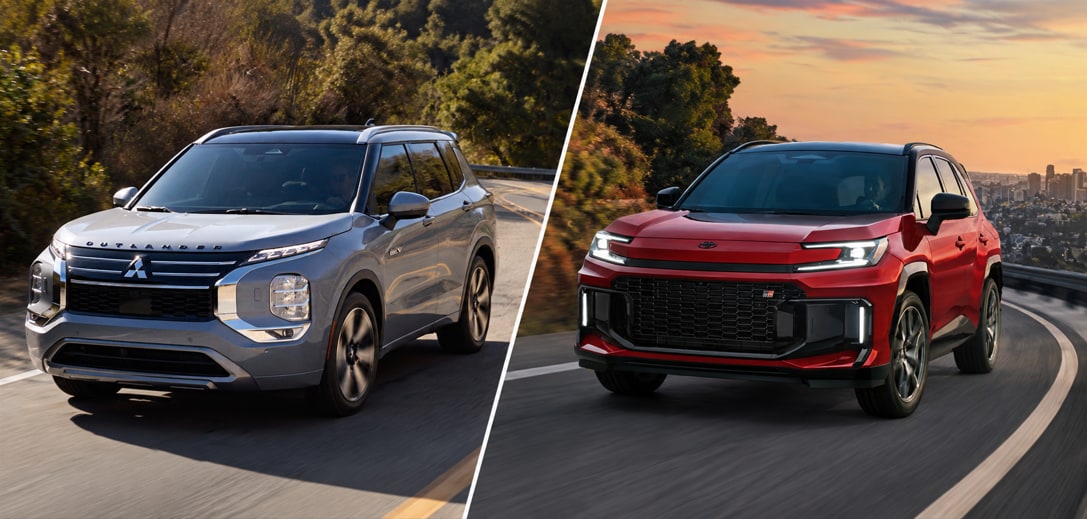
A spec sheet won't tell you how a vehicle handles a February morning on I-680, hauls a soccer team's worth of gear, or holds up over years of Ohio driving, and that's really what separates the 2026 Outlander PHEV from the Toyota RAV4 Plug-In Hybrid. Both SUVs blend electric range with gas backup, but they take different approaches to seating, power, and winter capability.
If you'd rather see the Outlander PHEV in person than read another spec sheet, you're welcome to browse our current inventory at Boardman Mitsubishi while you compare notes below.
Outlander PHEV vs. RAV4 Plug-In Hybrid: What Ohio Drivers Need to Weigh
Every Ohio driver comparing these two SUVs is really weighing a handful of practical questions. How far can each go on electric power before the gas engine kicks in? How does the AWD system handle a snow-covered rural road outside Youngstown? Does the cabin fit the family, the gear, and the weekend plans?
The Outlander PHEV offers seating for seven and a tow rating suited to light trailers, while the RAV4 Plug-In Hybrid brings a stronger EV range and higher horsepower. Both have their strengths depending on what you actually need day to day. Charging access matters too. If you can plug in nightly at home, a longer EV-only range pays off more than if you're relying on public charging around Boardman.
2026 Mitsubishi Outlander PHEV vs. Toyota RAV4 Plug-In Hybrid Specs at a Glance
The numbers below cover what matters most for daily driving decisions.
| Category | Outlander PHEV | RAV4 Plug-In Hybrid |
|---|---|---|
| EV-only range | Up to 45 mi | 54 mi (SE), 52 mi (XSE), 49 mi (Woodland), 48 mi (GR SPORT) |
| Combined MPGe | 73 MPGe | SE 101, XSE 96, Woodland 94, GR SPORT 86 |
| AWD system | S-AWC (Super All-Wheel Control) | Electronic On-Demand AWD |
| Horsepower | 297 combined hp | 324 net combined hp |
| Seating capacity | 7 seats | 5 seats |
| Cargo volume (seats up/down) | 30.8 / 64.7 cu ft | 33.5 / 63.5 cu ft |
The core tradeoff shows up right in this table: the Outlander PHEV prioritizes passenger capacity, while the RAV4 Plug-In Hybrid leans into power and EV range. Neither number tells the whole story, so here's what they actually mean on the road.
Electric Range, Charging, and Gas Backup for Ohio Commutes
Battery Size, EV-Only Range, and Charging Times
The Outlander PHEV delivers up to 45 miles of EV-only range and a combined range of roughly 420 miles, rated at 73 MPGe. A 240V (Level 2) charger will fully charge the Outlander PHEV in about 6.5 hours, per Mitsubishi, and SEL and Black Edition trims support CHAdeMO DC fast charging, which can bring the battery to 80% in about 29 minutes.
The RAV4 Plug-In Hybrid's EV range varies by trim, with EPA estimates of 54 miles for the SE, 52 miles for the XSE, 49 miles for the Woodland, and 48 miles for the GR SPORT. On XSE and Woodland trims, an 11kW AC charger paired with CCS1 fast charging can take the battery from 10% to 80% in about 30 minutes.
For an Ohio commuter making the round trip on I-680 between Boardman and Youngstown, either vehicle can likely cover the drive on electric power alone most days, assuming reliable overnight charging at home.
Combined MPG and Gas Backup on Longer Drives
Once the battery runs low, gas efficiency becomes the deciding factor for road trips or unpredictable weeks without charging access. Once its battery is depleted, the 2026 Outlander PHEV carries an EPA-estimated 27 mpg combined, a slight improvement over the previous model's 26 mpg.
The RAV4 Plug-In Hybrid's hybrid-mode mpg varies by trim as well: an EPA-estimated 41 combined mpg on the SE and XSE, 38 on the Woodland, and 37 on the GR SPORT. For drivers who frequently exceed their EV range on longer hauls, the RAV4 holds a real efficiency edge once it's running as a standard hybrid.
AWD Capability in Ohio Weather and Road Conditions
Winter driving around Boardman and Youngstown puts real demands on an AWD system, whether it's a patch of black ice on a hill or a snow-packed back road. The Outlander PHEV uses S-AWC (Super All-Wheel Control), Mitsubishi's twin-motor AWD system, with seven drive modes including Snow, Mud, Gravel, and Tarmac that adjust how power is sent to each wheel. That flexibility can matter on a morning when a rural road hasn't been plowed yet.
The RAV4 Plug-In Hybrid comes standard with Electronic On-Demand AWD, which biases toward front-wheel drive during steady cruising and engages the rear motor when it senses wheel slip. The Woodland trim adds dedicated off-road drive modes along with 8.5 inches of ground clearance, which can help on rougher terrain.
A few practical takeaways for Ohio drivers weighing AWD performance:
-
If you regularly drive hilly, unplowed roads outside city limits, the Outlander PHEV's selectable drive modes give you direct control over how the system responds.
-
If your winter driving is mostly highway and plowed suburban streets, the RAV4's on-demand system should perform reliably without much thought required.
-
Towing a small trailer or light equipment fits the Outlander PHEV's 1,500-lb rating, while the RAV4 SE, XSE, and Woodland are rated to tow up to 3,500 lbs for heavier loads like a small camper or larger boat. The RAV4 GR SPORT isn't rated for towing.
Seating, Cargo Space, and Family Practicality
Third-Row Seating: Outlander PHEV's Family Advantage
This is where the comparison gets clear-cut. The Outlander PHEV offers genuine 7-seat capacity, with a third row sized for children, and that's a real, factual differentiator rather than a marketing claim. For families running carpool duty or occasionally needing to fit a few extra kids for a weekend trip, that third row solves a problem the RAV4 simply can't.
The RAV4 Plug-In Hybrid is strictly a 5-seat vehicle across every trim, with no third-row option available. Toyota built this generation around a different footprint, and buyers who need to seat more than five regularly will run into that ceiling right away.
Cargo Capacity and Everyday Flexibility
Cargo numbers favor the RAV4 Plug-In Hybrid by a modest margin. With the seats up, it offers 33.5 cubic feet versus the Outlander PHEV's 30.8 cubic feet. Fold the seats down, and the Outlander PHEV actually edges ahead slightly with 64.7 cubic feet compared to the RAV4's 63.5 cubic feet.
In practice, both vehicles handle groceries, strollers, and weekend gear without issue. It comes down to whether that extra row of seats matters more to you than a few additional cubic feet of trunk space. For most Ohio families we talk to at our Boardman showroom, passenger flexibility tends to win out.
Technology and Safety Features Compared
Both SUVs come well-equipped on the tech front. The Outlander PHEV includes a 12.3-inch instrument cluster paired with a 12.3-inch touchscreen, wireless CarPlay and Android Auto, an available Head-Up Display, and Mitsubishi's MI-PILOT Assist driver-assist suite.
The RAV4 Plug-In Hybrid comes standard with Toyota Safety Sense 4.0 (TSS 4.0), a 12.3-inch instrument cluster, an available 12.9-inch display, and an Arene-based multimedia system.
On safety testing, IIHS has rated the 2026 Outlander PHEV's headlights Good, while the gas-powered 2026 Outlander has also earned a Good rating for side-impact protection and an Acceptable rating for whiplash protection. NHTSA has given the gas-powered 2026 Outlander a 4-star overall rating. For the redesigned 2026 RAV4, IIHS testing is still ongoing, and no NHTSA overall rating has been published yet for the RAV4 Plug-In Hybrid specifically.
Warranty Coverage and Ownership Considerations
Mitsubishi backs the Outlander PHEV with a 5-year/60,000-mile New Vehicle Limited Warranty, a 10-year/100,000-mile powertrain warranty for the original owner, 5-year unlimited roadside assistance, and 2-year/30,000-mile maintenance coverage, with the main drive battery separately covered to 10 years or 100,000 miles.
Toyota's coverage on the RAV4 Plug-In Hybrid includes a 10-year/150,000-mile hybrid battery warranty, 8-year/100,000-mile coverage on other hybrid components, a 36-month/36,000-mile basic warranty, and a 60-month/60,000-mile powertrain warranty. These are distinct coverage tiers, so it's worth reading the fine print on what's covered under each.
Beyond warranty terms, buying from a certified Mitsubishi dealer like Boardman Mitsubishi comes with practical advantages. Service scheduling is straightforward, and our factory-trained technicians handle PHEV systems and warranty claims regularly. If you're weighing whether a plug-in hybrid purchase might qualify for federal tax incentives, eligibility rules shift often. Check current guidance through official IRS resources or ask our finance team for help sorting out what may apply to your situation. When you're ready to look at the numbers, you can explore your financing options and find a plan that works for you.
Which PHEV SUV Fits Your Ohio Lifestyle?
Picking between the Outlander PHEV and the RAV4 Plug-In Hybrid comes down to which tradeoffs matter more for your household.
The Outlander PHEV works best for families, thanks to its third-row seating, and for winter driving, with its selectable S-AWC drive modes for hilly, unplowed roads. The RAV4 Plug-In Hybrid pulls ahead for long commutes, given its higher electric range across trims, for towing with its 3,500-lb rating, and for gas-mode efficiency on long trips once it's running as a standard hybrid.
Explore the Outlander PHEV at Boardman Mitsubishi
If the Outlander PHEV's third-row seating and winter-ready AWD sound like the right fit, the next step is simple.
-
Stop by our Boardman showroom for a test drive.
-
Browse our current inventory online to see what's available now.
-
Apply for financing when you're ready to talk numbers, no pressure attached.