
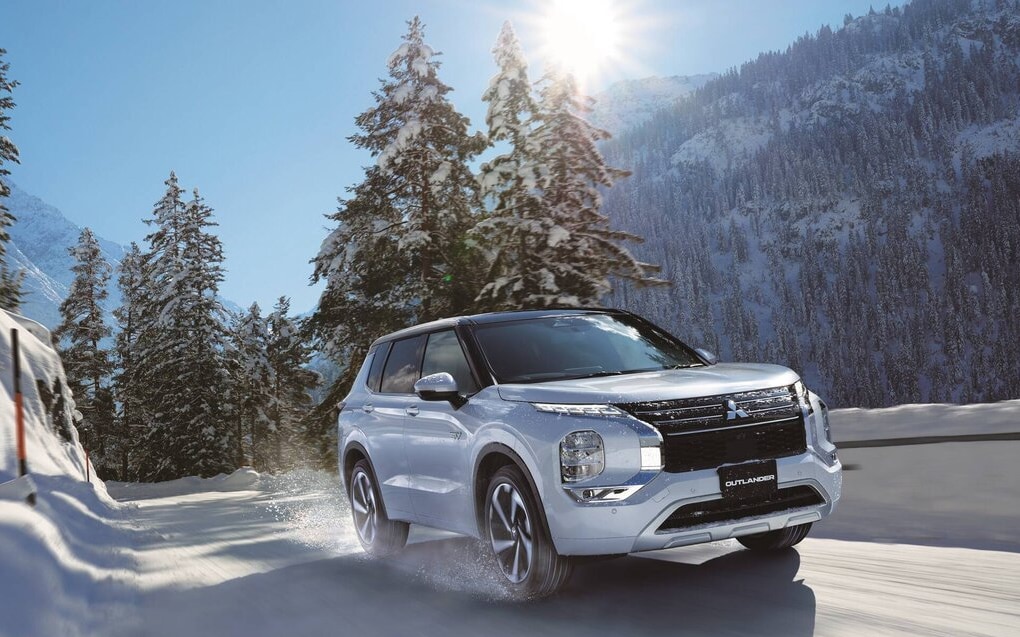
Ohio doesn't make driving easy. Lake-effect snow rolls in from the northeast, black ice forms overnight on I-680 overpasses, and freeze-thaw cycles turn familiar backroads into unpredictable surfaces by morning. Mitsubishi's Super All-Wheel Control (S-AWC) was built for precisely this kind of environment. If you want to experience the difference yourself, browse our new inventory to see which 2026 models bring S-AWC to Boardman.
S-AWC isn't a badge on a brochure. It's a system developed from competitive rally racing and engineered to handle the conditions Ohio throws at drivers every single season.
Why Ohio Roads Demand More Than Standard AWD
Ohio's climate puts drivers through the wringer on a regular basis. Winters around Youngstown and Boardman bring persistent snow, freezing rain, and black ice. Spring delivers saturated backroads and unpredictable drainage. Even a clear summer afternoon can turn into a heavy downpour that transforms a familiar highway into something far more demanding.
Standard AWD systems do a reasonable job of splitting power between axles and improving basic traction. The problem is they react to wheel slip after it's already happening, with little meaningful coordination between braking, steering, and power delivery.
For Ohio's variety of terrain and weather, that reactive approach falls short. What you actually need is a system that reads conditions and adjusts before things go wrong.
What S-AWC Actually Does: Smart Traction Without the Jargon
S-AWC works by coordinating multiple control systems at once: AWD torque distribution, AYC (Active Yaw Control), ASC (Active Stability Control), and ABS (Anti-lock Braking System), all functioning as a single integrated unit. Rather than operating independently and occasionally conflicting, these systems share information and respond together. The result is a vehicle that feels planted and controlled whether you're accelerating through a corner, braking on a slick surface, or picking your way along an unpaved trail.
Mitsubishi engineered S-AWC to be largely invisible in practice. It doesn't intrude on the driving experience or create artificial sensations. It simply keeps the vehicle doing what you intend, even when road conditions are actively working against that goal.
Longitudinal torque distribution front-to-rear and lateral torque vectoring left-to-right operate simultaneously, giving the system the ability to manage grip on all four wheels independently. For everyday Ohio driving, that kind of quiet competence is exactly what you want.
Torque Vectoring and Active Yaw Control Explained Simply
Torque vectoring sounds technical, but the concept is pretty straightforward. When you take a corner, your inside and outside wheels need to travel different distances. Sending equal power to both causes understeer, that frustrating sensation where the car pushes wide instead of following your steering input. Mitsubishi's torque vectoring directs more power to the outside wheel, helping the vehicle rotate naturally through the turn.
AYC builds on that by monitoring the vehicle's actual path versus your intended path, making constant micro-corrections along the way. Think of it as the system continuously asking "is the car going where the driver actually wants to go?" and adjusting accordingly. On a wet or icy corner, this combination keeps you on your intended line rather than drifting toward the shoulder.
For Ohio's mix of winding county roads and highway on-ramps, that kind of precision genuinely matters. There's also a Snow mode that optimizes torque distribution specifically for the wet, heavy snow Northeast Ohio is known for.
The Rally-Bred Roots That Make S-AWC Different
Mitsubishi didn't develop S-AWC in a vacuum. The technology traces directly back to the company's involvement in rally racing, including the World Rally Championship and the Dakar Rally, two of the most physically punishing motorsport disciplines in existence. Rally stages run over gravel, mud, snow, and wet tarmac, sometimes within the same stage, at speeds that demand absolute trust in how the vehicle handles.
That competitive background pushed Mitsubishi engineers to build a system capable of handling extreme transitions between surfaces and conditions. The lessons learned there, particularly around how torque distribution affects vehicle stability at the limits of grip, are baked into every S-AWC-equipped vehicle. It's a genuinely different foundation than a system designed primarily for marketing value.
S-AWC on Ohio's Toughest Roads: Real-World Confidence
Ohio's road network is a legitimate test for any AWD system. The state includes dense urban highways, rural two-lanes with minimal upkeep, hilly terrain in the east, and flat agricultural stretches in the northwest. Add four distinct seasons with real weather variation and you have an environment that quickly exposes weaknesses in vehicle dynamics. S-AWC handles this variety by continuously adapting to whatever it encounters.
Winter Driving on I-680 and Northeast Ohio Highways
I-680 around Youngstown sees serious winter weather. Lake-effect snow events can dump several inches in a matter of hours, and blowing snow reduces visibility while covering surface ice on overpasses. Commuters on this corridor need a system that manages traction during acceleration, holds stability through lane changes, and responds intelligently when braking on packed snow.
S-AWC addresses all of these scenarios by integrating with the vehicle's braking and stability systems. When wheel spin is detected during acceleration, the system redirects torque to wheels that have grip rather than simply cutting engine power.
During a lane change on a slick surface, AYC prevents the rear from stepping out. These aren't dramatic interventions. They're quiet, fast corrections that keep the vehicle stable and predictable in conditions where other systems would force you to slow down significantly just to stay safe.
Wet Pavement, Backroads, and Everyday Ohio Conditions
Winter gets most of the attention, but Ohio's wet conditions during spring and fall create their own set of challenges. Rain-soaked pavement reduces grip dramatically, and standing water on rural roads introduces real hydroplaning risk. S-AWC's constant monitoring of individual wheel speeds and torque distribution helps prevent wheel spin on wet asphalt, keeping acceleration smooth and controlled.
For drivers who occasionally venture off paved roads, whether that's a gravel driveway, a muddy Mahoning County backroad, or a trail through a state park, S-AWC provides the traction management that makes the difference between getting through and getting stuck. Vectoring torque to specific wheels means the system works with low-traction surfaces rather than simply spinning and hoping.
Which 2026 Mitsubishi Models Come with S-AWC
The 2026 Mitsubishi lineup brings S-AWC to several popular models, giving Ohio drivers access to this technology across a range of vehicle sizes and configurations. The table below outlines exactly where S-AWC appears in the 2026 lineup.
| Model | S-AWC Availability (Trims) | Drivetrain Type | Key S-AWC Feature Highlight |
|---|---|---|---|
| 2026 Eclipse Cross | Standard on all trims | Gasoline AWD | Torque vectoring on every configuration |
| 2026 Outlander PHEV | Standard on all trims | Twin-motor plug-in hybrid AWD | Dual electric motors enable precise left-right torque split |
| 2026 Outlander | Trail Edition trim only | Gasoline AWD | Full S-AWC capability for off-road and winter use |
The Outlander PHEV deserves a closer look because it pairs plug-in hybrid efficiency with full S-AWC capability. For Youngstown-area commuters managing fuel costs while still wanting capable winter performance, that combination makes a strong practical case.
Worth noting: the 2026 Outlander Sport uses standard AWC, not S-AWC. If S-AWC is a priority, the Eclipse Cross, Outlander PHEV, or Outlander Trail Edition are your options.
Ready to compare them in person? Browse our new AWD inventory or explore financing before your visit.
S-AWC vs. Conventional AWD: What Ohio Drivers Actually Gain
The comparison between S-AWC and conventional AWD often gets framed as a spec sheet exercise. It shouldn't be. The real difference shows up in situations where conventional AWD reaches its limits and S-AWC keeps working.
Conventional AWD divides power between front and rear axles but has limited ability to manage torque between the left and right wheels on the same axle. In a corner on wet pavement, the system can improve your ability to move forward but can't do much about the tendency to push wide or a rear end that gets unsettled.
Systems like Honda's i-AWD or Toyota's AWD-i operate primarily front-to-rear, with little lateral torque management. S-AWC addresses those exact scenarios through AYC and torque vectoring, which work laterally across the axle, not just front to back.
For Ohio drivers, the gains translate into more consistent behavior across the full range of conditions the state produces. Vehicles with S-AWC inspire confidence on a snow-covered on-ramp, a wet county road, and a dry highway in ways that conventional AWD simply doesn't replicate. Conventional systems aren't bad. S-AWC is just operating at a different level of sophistication.
Frequently Asked Questions About Mitsubishi S-AWC in Ohio
Is Mitsubishi S-AWC the same as standard AWD?
No. S-AWC adds active torque vectoring side-to-side and brake-based yaw control, adapting proactively to slips rather than reacting after the fact.
Which Mitsubishi models come with S-AWC in 2026?
The 2026 Outlander PHEV and 2026 Eclipse Cross include S-AWC as standard on all trims. The 2026 Outlander Trail Edition is equipped with S-AWC. The Outlander Sport uses standard AWC, not S-AWC.
How does S-AWC help with driving in Ohio snow?
S-AWC distributes torque longitudinally and laterally, uses brakes to prevent skids, and optimizes via Snow mode for confident handling on icy highways and backroads.
Schedule Your S-AWC Test Drive at Boardman Mitsubishi
Reading about S-AWC is useful. Feeling it work on an actual Ohio road is something else entirely. Schedule a test drive at Boardman Mitsubishi and put an S-AWC-equipped model through conditions you actually drive every day.
Visit Us or Reach Out
Boardman Mitsubishi is located at 883 Boardman-Canfield Rd in Boardman, OH, serving the greater Youngstown area with a full selection of 2026 models equipped with S-AWC. Our team takes a low-pressure approach, giving you the information you need to make a confident decision. You can also schedule service for your current vehicle while you're here.
Schedule Your Test Drive Today
Contact us to set up your visit, or browse our new inventory to find the S-AWC model that fits your life in Northeast Ohio.
Categories:
Technology